

Interview:
Art Rewards Gallery Oslo in conversation with Arnold August Nobis
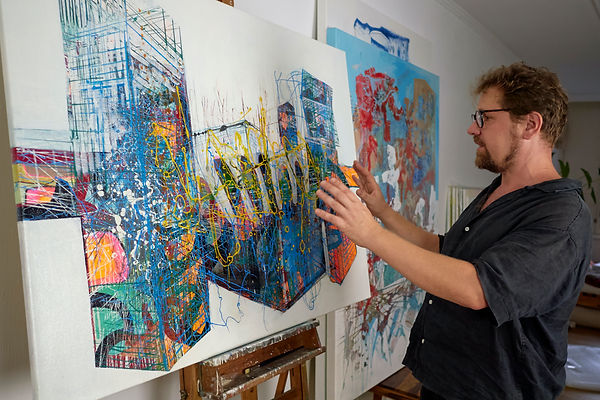
©Alistair Fuller
Art Rewards: Can you tell me about your background and how it influences your work?
Nobis: During my childhood, art and classical music were integral to my upbringing. My family placed great importance on these cultural elements, and we were frequently taken to museums and exhibitions to admire the masterpieces renowned classical artists. Comic books were highly frowned upon. Except for the magnificent "Astérix le Gaulois" created by René Goscinny and Albert Uderzo, most other comics were not appreciated and considered as a waste of time.
So, it was an initial act of rebellion when, at the age of twelve, I decided to create my own comic book. I developed the characters, the storyline, did the graphic design, and all the drawing work. This project took more than a year, and I had to enlist my best friend at the time to color the finished drawn pages. However, painting and drawing were more to me than just creating this comic book: I had developed a natural affinity for them, and these disciplines became my daily companions.
When I informed my parents after graduation that I wanted to become a graphic designer, they expressed that they would prefer I learn something more promising. So, I tried to meet their wishes and studied law and then water management and cultural engineering, both without passion and unsuccessfully.
And after the lectures, I spent most of my time again in front of the canvas and working on graphic designs. Eventually, my inner calling became strong enough to make a very important decision for my future life: In 1999, driven by my aspiration to become an artist, I made the bold decision to move to Spain, despite not speaking a word of Spanish at the time. By the spring of 2000, I had mastered the Spanish language well enough to apply for admission to the applied sculpture class at the Escuela de Artes de Pamplona. Up until that point, I had mainly focused on graphics and painting. However, when I took my first visit to the Escuela de Artes de Pamplona and glanced into the sculptors' workshops, I knew it was time to expand my artistic repertoire.
After graduating in Pamplona as a "Higher Technician of Plastic Arts and Design of Applied Sculpture",
I moved to Bilbao to study at the Faculty of Fine Arts. I attended the oil painting class with great enthusiasm and soon rented an old factory hall to set up my first large studio, where I could work on my painting intensively and undisturbed. I prepared for my first solo exhibition in Guernica and began experimenting with materials and techniques.
Art Rewards: Who are the artists that have had the greatest impact on your work?
Nobis: Having delved into the study of applied sculpture in the Basque Country, it becomes apparent that the profound influence of Basque sculpture has left an indelible mark on my artistic pursuits.
I was captivated by Jorge Oteiza's idea of defining the interior space as the true essence of sculpture. Let me explain it this way: Imagine wrapping a bale of straw with thick iron wire and then placing this bale into a fire. What remains is the iron wire, which has taken on the contours, the form of the straw bale. The sculptural result, what truly interests us, is not the iron wire itself, but the space it encloses and defines. The space as sculpture, as an object.
I have translated this concept into painting: Through the multi-layered structures on the canvas, a sense of spatial depth unfolds before the viewer, as if they could peer into the canvas itself. This spatial sensation extends into infinity, or at least to the edge of the canvas. However, by taking it a step further, the space is now declared an object—I encircle this view into the depth with a silhouette, transforming it into a potentially recognizable object for the viewer. From a distance, the viewer perceives an object, perhaps a head or a city; up close, it feels as though one could gaze through a window into a space beyond the canvas.
As a painter, I was inspired above all by the great masters: Van Gogh, Monet, Kandinsky, Picasso, Pollock, Klimt, Mondrian, Basquiat, etc. What these artists all have in common for me is their absolutely unmistakable style. And of course my two heroes René Goscinny and Albert Uderzo.
Art Rewards: Share with me your favorite medium.
Nobis: In the past, I have added coffee powder and bitumen, to many of my works. I have increasingly left these two materials aside in the further development of my painting techniques: Currently, I work mainly with acrylic paint, as one of my techniques has been refined to achieve painterly depth effects.
Art Rewards: Where do you find inspiration?
Nobis: If I want to be consciously inspired, then I seek out beautiful or wild and rough places in the wild untouched nature: misty mountain heights, forests, stormy coasts, idyllic meadows and so on. Nature probably nourishes my artistic feeling most strongly of all the stimuli to the eye.
At the same time, I am a friend of urban impressions: in the environment of modern architecture, crowded nightclubs, rainy cobbled winter streets or dizzyingly high towers. And then, of course, there is the human body: to be explored again and again.
Art Rewards: Describe how art is important to society.
Nobis: In my view, art has been intricately woven into the fabric of humanity since the dawn of civilization.
The earliest artifacts—ritual objects, grave goods, and more—are imbued with artistic intent, reflecting an inherent human appreciation for aesthetics. Yet, I find it challenging to articulate the role that art plays in our society today. At times, it feels as though contemporary art offers a sanctuary from the complexities of reality, providing a space for reflection and introspection when I immerse myself in a modern art exhibition.
This duality of art as both a mirror and a refuge continues to provoke thought and inspire dialogue in our ever-evolving cultural landscape.
And then sometimes I walk through an exhibition and discover a piece that magically and magnetically draws my attention. I stand before it, understanding nothing, yet simultaneously overwhelmed by the energy emanating from it. I am simply grateful and think, "Thank goodness someone created this—otherwise,
I would have had to do it myself!“
So yes: it is important to us to introduce new ideas into the world for society and for people, to provide new stimuli for thought, to create a conceptual manifesto. As we, as humans, continue to evolve, through the presentation and exhibition of art, we can enrich one another and hopefully make the world a better place.
Art Rewards: How do you define success as an artist?
Nobis: The artistic life gives me many small and large opportunities to celebrate successes or to overcome setbacks. I see every exhibition participation and every work sold as a success of my work.
A small success story, which I still draw on and like to tell, was the work as a stone sculptor on the tombstone of the actor Sir Alec Guinness, who portrayed the Jedi Master Obi Wan Kenobi in George Lucas' Starwars -
Not a great artistic success, but a very nice anecdote to tell.
In any case, a tangible success from the artistic work is the personal development as an artist, the refinement of processes and the crystallization of elements through patience and dedication.
Art Rewards: Does art help you in other areas of your life?
Nobis: Absolutely. Art gives me driving force through enthusiasm and interest in life itself and the urge to translate this enthusiasm artistically and make it perceptible to other people. The desire to create gives me additional energy that goes far beyond the amount of available daily energy.
Furthermore, I see art with its various disciplines as life-enriching metaphors - it helps me to better understand problems in everyday situations of life and to look at them from a different perspective.
Art Rewards: How do you develop your art skills?
Nobis: From a purely artisanal perspective, as a painter, I must not only engage in the development of techniques but also devise new visual perspectives that must be comprehensible to the viewer. This polar discipline of abstraction between the object and the observer can be expanded indefinitely. The history of the development of Cubism illustrates this principle very well.
Furthermore: In my opinion, artistic skills are enhanced and expanded through a constant interest in the world and society, in reflection with the inner, subtle perceptions as an artist, and the expression of these ideas and feelings through artistic work.
Personally, I let my work flow through me in a mood of vibrant creativity, followed by alignment and reflection as I contemplate my work. A piece of art is only harmonious for me once it has withstood my own critical scrutiny.
Art Rewards: How can your work affect societal issues?
Nobis: The confrontation with coffee powder and bitumen twenty years ago (2004) dealt with the topic of climate change, which is so hotly debated today. The coffee stands for the drive of people and bitumen for the drive of the machines - so I was already very interested in the development of humanity in terms of technical progress and tried to incorporate this into my work.
At that time, society had not yet seized upon this hot topic, and I had dealt with it personally. During an exhibition presentation, my interest in bitumen as a byproduct of oil production was misinterpreted as a tribute to the fantastic possibilities of synthesizing oil. In hindsight, this means I need to stay attuned to the zeitgeist while being cautious about interpretation, as distortion can always occur. Art can observe society, critique it, or completely ignore it. As artists, we have the opportunity to hold up a mirror to society.
About ten years ago, when I was temporarily working as a high school teacher in the subjects of graphics, painting and sculpture, I discovered the fantastic possibility that with and through art all the topics that moved the students at that time could be discussed and addressed - death, sexuality, war, violence, power and abuse of power, humor, etc. - We discussed in class just all the topics that that these young people could not address in the other subjects at school. Art gives us this freedom.
Art Rewards: How do you navigate the professional art industry?
Nobis: I believe that today's time with digitization poses great challenges for the artist and at the same time offers an incredible number of possibilities. In any case, as an artist, I not only have to understand my craft, organize and document my work logistically. I also have to take care of the data processing, my marketing strategies, the presentation in the digital networks and so on.
This takes a lot of time and work.
At the same time, the original piece of art no longer has to be sent around the planet to be seen by viewers. Unfortunately, the work loses a lot of its expressiveness, as perception with all the senses is reduced to optical and intellectual perception via the screen. When I have an original work before me, I simultaneously perceive the subtleties and details on the canvas as well as the larger whole.
So, I still prefer to present my paintings from person to person—musically speaking, as a live act. And that requires a lot of logistics: storage, transportation, and management. Just like a rock band touring from city to city with all their equipment.
Thanks to the World Wide Web, visual art can be made accessible to almost everyone, and that's a truly fantastic thing!
Art Rewards: What are your favorite and least favorite parts of professional art?
Nobis: The most beautiful thing for me is to stretch a new canvas on a frame and enjoy the moment before I make the first brushstroke. On the other hand, I find the logistical part of my work, packing the works,
storing and transporting, rather strenuous and tiring.
Art Rewards: What have critics and collectors said about your artwork?
Three collectors testimonials:
Very early in Arnold Nobis’ career, I had the opportunity to acquire three similar looking paintings. The blue he uses in these works fascinates me. The strong contrast to the other colors he uses in these works are created in a way that they do not cancel each other out. A second, more delicate painting hangs in my bedroom, and every time I lie down and read, I can lose myself in these surfaces and levels that present themselves to me again and again. The things I see change every time I look at it…
I have been following his work, and I like many of the new paintings. A lot.
Unfortunately, I don't have the financial backing, but I know what I'm saving for. The only thing missing is the right wall for it... In my daughter's room hangs another picture, and after living with it for two years until now, she finds the following words: "It's a beautiful picture. I never get bored of looking at it. Since it is very abstract, I always discover new things and levels. When I move out later, I would like to take it with me"
- S. Kneucker, Collector -
Together with my wife we are the lucky owners of five of Arnold Nobis’ works. The paintings are displayed in our home and we wouldn’t want to miss a single one of them. One of the paintings, exclusively in black and white and deep through its simplicity of form, greets visitors upon entering. The other paintings, more colorful and, perhaps, dramatic, never seize to impress our guests.
The one thing preventing us from acquiring more of Nobis’ paintings is the lack of wall space in our home. After all, we love looking at his paintings and would hate to just store them without being able to look and study them every day. Even though we must have looked at each of Nobis’ paintings we own thousands of times, they never cease to reveal something new. Sometimes it is a minor detail regarding form, color or texture, sometimes it is a major new way of interpreting the painting altogether.
- R. Kogler, Collector -
In our house, we are delighted to have three paintings by Arnold Nobis:
The "Quadratschädel" in the recording studio, my workspace, which reminds me of (irrational) artistic freedom while working creatively. The many fine and sharp lines that merge together into a soft outline of a bust with a graduation cap are fascinating.
In the bedroom, a painting that could depict the Big Bang with its concentric circles, gracing us with a touch
of gentle ocean waves through its delicate blue tones.
And actually, in the hallway, there’s a painting from the "Spanish phase," where soft, hieroglyphic-like white symbols come together to form a whole, surrounded by delicious brown and black coffee tones.
… "Actually" because it has been adorning the wall of our 19-year-old son's room for the past two years. :)
Thank you, Arnold, for your wonderful artworks!
- M. Schallmayer, Collector -

©Alistair Fuller
Art Rewards: What factors influence the price of your work?
Nobis: The pricing of my artworks depends on the following factors: the amount of work involved, the size of the piece, and participation in a competition or an international exhibition. It makes a financial difference to me how much a piece has already traveled around the world, which, of course, increases its value. And then, of course, there is the personal value.
Art Rewards: What are your ultimate career goals?
Nobis: An exhibition at the Tate Modern in London would be a fine thing. Or a spacious studio with a view of the sea. There is still a lot of room for improvement!
Should I be endowed with ample resources, I would choose to establish an art school dedicated to preserving the fine arts. This institution would provide essential craftsmanship skills and interdisciplinary artistic education, enabling young people to honor timeless values while infusing the contemporary zeitgeist into the enduring expression of the human spirit.
Art Rewards: How do you manage a work-life balance as an artist?
Nobis: Being an artist is a permanent companion. Art, work and private life are constantly mixed with each other for me. I can't just turn off my interest in art. Often I am spontaneously inspired, ideas just come up into my consciousness and I try to sketch or write them down, in case I want to fall back on it one day.
On the other hand, I strictly separate, when I actually stand in front of the screen, because that takes preparation time and planning for me.
Art Rewards: What are your messages for the other artists?
Nobis: I think the most important thing is to develop your own unmistakable style and never lose the joy and enthusiasm for your work. So have fun, take it seriously, work hard, and express through art what perhaps cannot be conveyed by any other medium.
As an artist, one should be interested in the world that surrounds us and in people. At the same time, one should be skilled, serious, and yet not lose the lightness and humor.
I recently read a quote, though I can't remember who it's from: "Art is a game—an artist is someone who takes this game seriously."